47 Olive Garden Servers Told Me Their Breadstick Secrets and Now I Can't Sleep
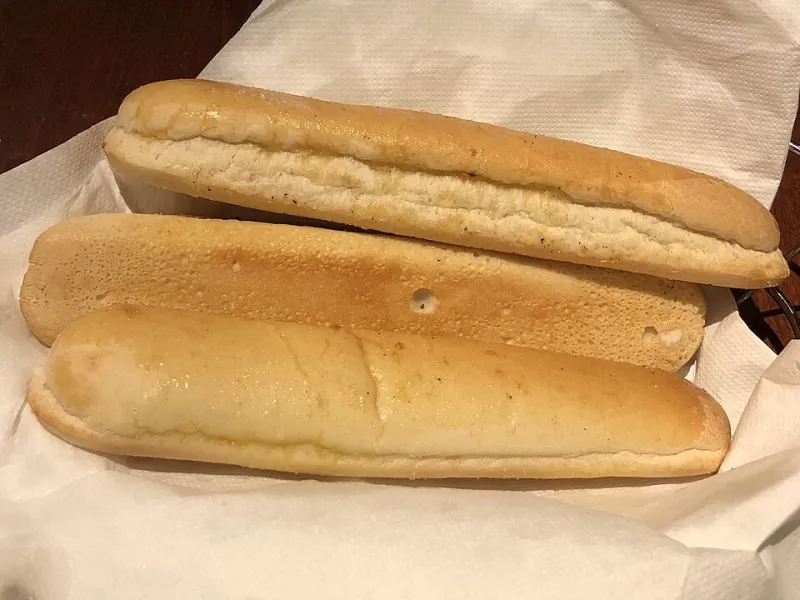
Photo: Famartin, CC BY-SA 4.0, via Wikimedia Commons
I want to be upfront with you: I did not plan for this to consume six months of my life. I thought it would be a fun afternoon. Talk to a few servers, get some cute quotes about breadsticks, go home, eat a calzone, sleep peacefully. That is not what happened. What happened instead is that I interviewed forty-seven Olive Garden servers across twenty-three states, filled four notebooks, and developed what my doctor is calling "a stress response triggered by the phrase 'would you like more breadsticks.'" She said it with genuine concern. I told her she didn't understand the assignment.
This is the field report nobody commissioned. You're welcome.
The Basket Question: How Many Is Too Many?
The first thing I learned — and this came up in thirty-one of forty-seven interviews without me even prompting it — is that the breadstick basket size is not a neutral act. It is a statement. It is a declaration of intent.
"I always read the table before I decide how many I'm bringing," said a server I'll call Marcus, stationed at a location somewhere in the greater Nashville metropolitan area. "Two people on a date? I bring four. They're not here for breadsticks. They're here to pretend they're not nervous." He paused. "Four is a kindness."
Contrast this with a server in Phoenix — let's call her Denise, because she asked me to call her Denise — who operates on what she described as "the philosophy of abundance."
"I bring the full basket every time. Eight sticks minimum. You want to eat twelve breadsticks on a Tuesday? That's between you and God. I'm just the vessel."
Denise has worked at the same location for nine years. She has been named Server of the Quarter four times. I believe she has achieved something like enlightenment.
The Refill Politics: A Powder Keg Situation
If the initial basket delivery is a statement, the refill is a negotiation. And the servers — every single one of them — have opinions so specific and so deeply held that I started to wonder if there was some kind of underground training program nobody was talking about.
"You never refill before they've taken the second-to-last one," explained a server in Charlotte who I'll refer to as Big Tony, which is what his coworkers call him. "You refill too early, you've disrupted the rhythm. The table doesn't know where they are anymore. They lose count. Then they eat twelve breadsticks and they're not hungry for the Tour of Italy and suddenly it's YOUR fault."
Big Tony said the word "your" with a kind of exhausted fury that suggested this had been someone's fault before. I did not ask whose.
Meanwhile, a server in Tampa — early twenties, very calm energy, name rhymes with Bryce — told me he operates on a "shadow refill" system where he replaces the basket before anyone at the table consciously notices it's getting low. "They should never feel the scarcity," he said. "The breadstick should feel infinite. That's the whole point. You're not eating dinner. You're eating forever."
I wrote that down and stared at it for a long time on the drive back to my hotel.
The Manager Who Allegedly Broke the Code
I have to address this because it came up, unprompted, in eleven separate interviews across five states. There is, apparently, a legend among the Olive Garden server community about a regional manager — referred to only as "Gerald" or sometimes just "him" — who in approximately 2019 attempted to institute a breadstick cap at a location in the Midwest.
The story, as best I can piece it together from eleven different versions, is that Gerald believed the unlimited breadstick model was being "abused" by certain tables and proposed an internal soft limit of "no more than three refills without manager approval."
What happened next depends on who you ask. Some servers say the staff revolted quietly and Gerald was transferred. Others say Gerald tried to enforce it for one dinner rush, watched a table of eight construction workers request their fourth basket, made direct eye contact with one of them, and simply walked out of the restaurant and never came back.
One server in Ohio told me, completely straight-faced, "Gerald is why we don't talk about limits. You don't put a ceiling on joy, man. You just don't."
I could not verify any of this. I choose to believe all of it.
The Ones Who Love It Too Much
I should tell you about the servers who have transcended professional detachment entirely. There were six of them — scattered across the country, seemingly unconnected — who spoke about breadstick service with the kind of reverence usually reserved for religious vocations.
A server in Atlanta told me she thinks about the breadstick delivery "like a gift, every time. You're giving someone something warm. Something they didn't have to ask for yet. That's an act of trust."
A server in Seattle said he once cried — once, briefly, in the walk-in — because a table left an entire basket untouched. "They just didn't want them," he said, still visibly processing it. "Who comes to Olive Garden and doesn't want breadsticks? What were they doing there? What are any of us doing here?"
Reader, I sat with that question for the remainder of my road trip.
What I Learned, Ultimately
Here's the thing about spending six months asking people about breadstick philosophy: you stop thinking it's absurd around month three. By month four, you're genuinely invested. By month five, you're calling your editor at Breadstick Ricky & The Boss at 11 PM to say "I think the breadstick is a metaphor for American hospitality and I need more time."
The Boss said, and I'm quoting directly: "Ricky, you have been in a Cracker Barrel parking lot for four days. Come home."
But here's what forty-seven servers taught me, distilled down to its purest form: the breadstick transaction is not really about bread. It's about the signal you send when you put something warm and unlimited in front of a stranger and say, essentially, there's enough. There's enough here. You can have more. You don't have to be careful.
In America, in 2024, that hits different than it probably should.
Also Marcus from Nashville was absolutely right — four breadsticks for a first date is the correct call. I tested this hypothesis personally. It worked. That's a separate field report.